Tampilkan postingan dengan label Curriculum Connection. Tampilkan semua postingan

Rabu, 02 Januari 2013

Challenged Children Reads

  While I didn't get a chance to completely finish my Banned/Challenged reading challenge from last year, I did manage to squeeze in a few more reads before the challenge's deadline. I've read many stories about the following books but haven't actually read them until now.

Description: Fearing that her legal guardian plans to abandon her to return to France, ten-year-old aspiring scientist Lucky Trimble determines to run away while also continuing to seek the Higher Power that will bring stability to her life.

Review: It's a shame that one word overshadowed a great book. The Higher Power of Lucky is story of a young girl named Lucky who lives in tiny, poor town Hard Pan, California with her dog and the young French woman who is her guardian. Her mother died in a thunderstorm and her father handed her over to his first exwife, a French woman named Brigitte. With a personality that reminded Ramona Quimby, a character that I absolutely adored,  Lucky is contemporary and relate-able. She teeters between being a grown-up that can easily gather insects and scares away snakes without any hesitation yet she is vulnerable and fears that her guardian will leave her to return to France at any moment. Looking for solace, Lucky eavesdrops on the various 12-step meetings held in Hard Pan, hoping to discover her own higher power that will see her when she hits 'rock bottom'. Peppered with memorable secondary characters such as her best friend and crush, Lincoln, who has a fixation for tying knots, and a little, adorable yet pesky toddler named, Miles, who can relate to Lucky's fears. Patron's plotting is as tight as her characters are endearing. Lucky is a true heroine, especially because she's not perfect: she does some cowardly things, but she takes pains to put them to rights.

Rating: 4 stars

Reason why it was banned/challenged: There was a big controversy when the book was published, specifically because the word scrotum appears a handful of times throughout the book. Lucky first hears of the word while eavesdropping on a conversation when a character says he saw a rattlesnake bite his dog, Roy, on the scrotum. Many educators including elementary school librarians felt the inclusion of the "s-word" was highly inappropriate and unnecessary. They even called for the book to be removed from library shelves and some even thought the book should be stripped of its Newbery award. I, personally, feel that the inclusion of the word is a nod to Lucky's curiosity which natural for her age. Though she wonders what the word means as she thinks it's important, she isn't fixated on it and nor does it drive the story. Unfortunately, this controversy has overshadowed the book's importance. Most people including me had to really think of the book's real title instead of referring it as the book with the "S-word". To read more about the controversy, read the New York Times article and then the author's response as well as her interview.

Words of Caution: None. Recommended for Grades 3 and up.

If you like this book try: Lucky Breaks by Susan Patron, Walk Two Moons by Sharon Creech, Waiting for Normal by Leslie Connor
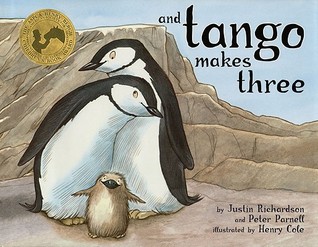

Description: At New York City's Central Park Zoo, two male penguins fall in love and start a family by taking turns sitting on an abandoned egg until it hatches.

Review: And Tango Makes Three is based on a true story about a charming penguin family living in New York City's Central Park Zoo. In this heartwarming story, readers will meet Roy and Silo, two male penguins, who are "a little bit different" than the other penguins. They cuddle and share a nest like the other penguin couples, and when all the others start hatching eggs, they too want to be parents. Determined and hopeful, they bring an egg-shaped rock back to their nest and proceed to start caring for it. They have little luck, until a watchful zookeeper decides they deserve a chance at having their own family and gives them an egg in need of nurturing. The dedicated and enthusiastic fathers do a great job of hatching their funny and adorable daughter. Done in soft watercolors, the illustrations set the tone for this uplifting story. The words are matched well with the illustrations and the message of tolerance and a broader definition of family is well received.

Rating: 4 stars


Reason why it was banned/challenged: And Tango Makes Three is frequently challenged since its publication of 2006. It has appeared on the list several times between 2006 and 2010 for the following reasons: homosexuality, religious viewpoint, and unsuited to age group. 

Words of Caution: None. Recommended for Pre-school to Grades 3. Though the book is about two male penguins, I don't see any agenda of imposing homosexuality to kids, but rather showing that a family no matter how family is designed all have the same concepts at its core: love, warmth, and tolerance. What are we telling kids who are raised by GLBT adults? That they aren't loved and they aren't normal? It amazes me that a simple book like Tango can generate so volatile opinions while TV shows like Modern Family that also features two male partners raising a child can garner so many accolades and be accepted by so many people.

If you like this book try: The Family Book by Todd Parr, The Very Best Daddy of All by Marion Dane Bauer

Description: A retelling of a mother's account of what happened to her family during the Flash that destroyed Hiroshima in 1945.

Review: Hiroshima No Pika is a striking picture book that details one of the horrific events of history: the dropping of atomic bomb in Hiroshima, Japan. The book is filled with watercolor paintings which reinforce the colors of flames and debris, vividly heightening this low-key text recounting the fictionalized experiences of a 7-year-old Hiroshima child and her mother after the 1945 "Hiroshima flash." The story told in precise and easy sentences send chills down your back with its easiness. Like most people, you only hear about the event but when you read Hiroshima No Pika, you are given a tiny glimpse of what true horror is really like.

Rating: 4 stars. Recommended for Grades 4 and up.

Curriculum Connection: Social Studies


Reason why it was banned/challenged:  According to the MVCC Libraries, the book was challenged because it "does not depict war as glorious (graphic depiction of   victims of bombing of Hiroshima).

Words of Caution: There is nudity and strong images of violence. The book does not shy away from the dark side of war: causalities, destruction, and an abrupt change to life. The pictures, though hard to take in because of how much is inflicted by the people of the story, show just enough detail of horror without going overboard. Though not a book that would used as a read-aloud, it would serve a great purpose in discussing World War II with mature students such as older elementary students and above who can understand the book and its context. 

If you like this book try: Baseball Saved Us by

Rabu, 12 Desember 2012

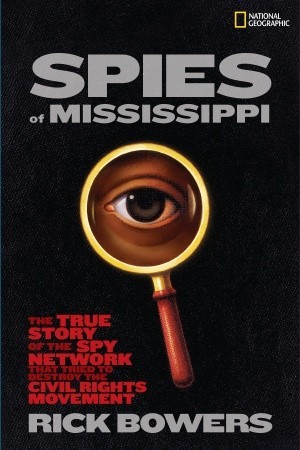
Spies of Mississippi

  When you think of the Civil Rights Movement, what words and people suddenly pop into your mind? Martin Luther King, Jr., Rosa Parks, Malcolm X, Jim Crow laws, segregation, and sit-ins are just a few that I can think of this morning, but I'm sure you can come up with much more. Never would I have thought spies would also be in that mix until I read Rick Bower's chilling and eye-opening book called the Spies of Mississippi: The True Story of the Spy Network That Tried to Destroy the Civil Rights Movement.

Description: In the 1950s and 1960s, the Mississippi State Sovereignty Commission compiled secret files on more than 87,000 private citizens in the most extensive state spying program in U.S. history. Its mission: to save segregation.

Review: Drawing upon archival material, his impeccable research and personal investigation, Bowers has uncovered something new in the much discussed topic of the Civil Rights movement in the U.S. In 1956, the state of Mississippi created a Sovereignty Commission that started as a propaganda outlet for white supremacy quickly morphed into a full blown spy network, with a goal of stopping integration and crushing the civil rights movement in the state.
 In extensive details, Bowers discusses the Commission's tactics that were appalling and disregarded the constitutional rights for those who supported or aided the cause as well as the scope of this network's activities from its initial attempts to control or marginalize the NAACP and resist public and school and university integration into outright advocacy of violence and obstruction of justice. Although the Commission was thankfully abolished due to the federal civil rights legislation and the threat of financial sanctions, the author still warn his readers that racism is just as alive today as it was back then. Period black-and-white photographs, an appendix with reproductions of selected Commission documents, and an extensive bibliography of books and links to online archives supplement the text, making this a great resource for young readers doing a research project on the Civil Rights movement. Spies of Mississippi is a an eye-opening and powerful experience. 

Curriculum Connection: Social Studies

Rating: 4 stars

Words of Caution: Race riots and violence are discussed. Recommended for Grades 6 and up.

If you like this book try: They Call Themselves the K.K.K. by Susan Campbell Bartoletti, Claudette Colvin by Phillip Hoose

Rabu, 05 Desember 2012

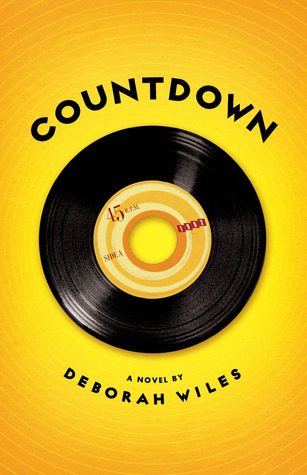
Countdown (Sixties Trilogy #1)

 I know some readers aren't overly fond of historical fiction, but I really do enjoy the genre as I learn details of history while reading an enjoyable story. For instance, I've heard about the Cuban Missile Crisis in school, but I didn't under the crisis part exactly until I read the first book in the planned Sixties trilogy, Countdown by Deborah Wiles.

Description (from the Publisher): Franny Chapman just wants some peace. But that's hard to get when her best friend is feuding with her, her sister has disappeared, and her uncle is fighting an old war in his head. Her saintly younger brother is no help, and the cute boy across the street only complicates things. Worst of all, everyone is walking around just waiting for a bomb to fall. It's 1962, and it seems the whole country is living in fear.

Review: Franny lives with her family in suburban Maryland just outside Andrews Air Force Base, circa summer of 1962. President Kennedy and Soviet Union leader Khrushchev duel on the possibility of a nuclear war. The world crisis continues in the background while Franny worries about her best friend's betrayal; adores her college-age sister, Jo Ellen; and fights with her saintly little brother, Drew. When not riding the tumultuous ride of early adolescence, she writes letters to Khrushchev, advising him to drop his threats and think rationally, prepares for air-raid drills, and investigates her sister's coded letters from someone named "Ebenezer."
  Countdown is a straightforward historical fiction that at times reads like a memoir. Unlike other historical fiction reads that I've read, it has a unique format. In a successful effort to give readers a sense of the country's total preoccupation with all things nuclear and Communist during the height of the Cold War, Franny's narrative is punctuated by newspaper clippings, advertisements for bomb-shelter materials, news broadcasts, brief vignettes about famous figures, ephemera, and more. All of these snippets of time period would make me anxious and feel bombarded with confusion and fear, which is similar to what Franny is feeling at the moment. I can definitely see how this format may not work with some readers, but if the time period and the events draw your interest I would highly recommend listening to the audiobook which was done very well. With the audiobook, you don't have to be afraid of the 'textbook' feel because the documentary format comes alive and Franny's coming of age is much more personal. Countdown is a great historical fiction read and I am looking forward to the other books in this Sixties trilogy.

Curriculum Connection: Social Studies

Rating: 4 stars

Words of Caution: Violence such as the race riots of the 1960s are in the back drop of the book. It is hinted at several times but not described in details. Recommended for Grades 5 and  up.

If you like this book try: The Fire-Eaters by David Almond, Shooting the Moon by Frances O'Roark Dowell

Selasa, 23 Oktober 2012

Such Wicked Intent (Apprenticeship of Victor Frankenstein #2)

  Are you looking for a gothic,ghostly read that isn't overly scary for you? Then I would suggest picking up Kenneth Oppel's new series called the Apprenticeship of Victor Frankenstein, which is a re-imagined origin story of Shelly's anti-hero. Such Wicked Intent is the perfect read for this Halloween season.

Description (from the publisher): When does obsession become madness? Tragedy has forced sixteen-year-old Victor Frankenstein to swear off alchemy forever. He burns the Dark Library. He vows he will never dabble in the dark sciences again—just as he vows he will no longer covet Elizabeth, his brother’s betrothed. If only these things were not so tempting.

When he and Elizabeth discover a portal into the spirit world, they cannot resist. Together with Victor’s twin, Konrad, and their friend Henry, the four venture into a place of infinite possibilities where power and passion reign. But as they search for the knowledge to raise the dead, they unknowingly unlock a darkness from which they may never return.

Review: Such Wicked Intent begins three weeks after the events of This Dark Endeavor took place. We find Victor and his family in mourning for their terrible loss. He rejects alchemy and complies with his father to burn down the Dark Library where he first heard of the Elixir of life. All of the books in the library burn with the exception of one. Soon visits to a spirit world and discovery of an ancient text on the wall of a cavern beneath the chateau revive Victor’s hopes, leading him to attempt creation of a replica body for Konrad’s spirit to inhabit. Of course the traveling back and forth from the spirit world has consequences, but that doesn't stop Victor's obsession nor does it quell Elizabeth's yearning to hold her fiance once again.
  This Dark Endeavor presented us with a love-triangle with Konrad and Victor pitted against one another for their affections for Elizabeth. Such Wicked Intent now turns the triangle into a square by adding another pursuer of Elizabeth's heart which complicates matters, as does Victor’s growing obsession with power. How far is he willing to go to bring his brother back to life? Does he really want to re-animate his brother? And for whom? What else could he learn from the spirit world? Oppel fleshes out these questions through Victor’s internal moral quandaries and continued scheming.
  I loved the vivid descriptive language found in the book and the further character development of the main characters. I like how Oppel uses Elizabeth, the symbol of passivity as well as Victorian female virtue in the original novel, as a three dimensional person who has her own selfish desires despite her tireless efforts to stay true to societal's conventions in his story. The conflict of interests among all of the characters keep the narrative intense and engaging. The reoccurring theme of science versus religion is done very well without being too heavy handed. While the dark supernatural powers and the back-and-forth travel to the spirit world aren't necessarily plausible, however, Oppel's great storytelling skills doesn't make us seem to notice. Plus, there isn't really much of an explanation in the original Frankenstein of what mixture of science and magic Victor exactly used to create his monster.
  Though Victor learns an important lesson at the end of this book, there is still the curiosity and the drive to see how far humans can go with science in the back of his mind that is not only very chilling but in a morbid way excites us to learn what boundaries he will cross next.

Curriculum Connection: Use to accompany the original novel.

Rating: 4 stars

Words of Caution: Mild PG language, an attempt at sexual assault, and some disturbing images. Recommended for strong Grades 6 and up particularly for those who enjoy historical fiction, horror, and adventure with a minor romance subplot.

If you like this book try: Frankenstein by Mary Shelley, Death Note manga series by Tsugumi Oba, Clay by David Almond, Prodigal son by Dean Kootz (an adult book with YA appeal)

Rabu, 17 Oktober 2012

The Mark of Athena (Heroes of Olympus #3)

  While the Heroes of Olympus is a spin off series of the Percy Jackson, I highly recommend that readers read the Percy Jackson series first in order to get a proper introduction to Camp Half-Blood and several major characters that are from the prior series as well as the first two books in the Heroes of Olympus series. Otherwise readers may feel like they are dropped into a middle of a series and be a bit confused as to what is going on. The review below does not contain any spoilers for The Mark of Athena.

Description (from the publisher): In The Son of Neptune, Percy, Hazel, and Frank met in Camp Jupiter, the Roman equivalent of Camp Halfblood, and traveled to the land beyond the gods to complete a dangerous quest. The third book in the Heroes of Olympus series will unite them with Jason, Piper, and Leo. But they number only six--who will complete the Prophecy of Seven?
   The Greek and Roman demigods will have to cooperate in order to defeat the giants released by the Earth Mother, Gaea. Then they will have to sail together to the ancient land to find the Doors of Death. What exactly are the Doors of Death? Much of the prophecy remains a mystery. . . .
With old friends and new friends joining forces, a marvelous ship, fearsome foes, and an exotic setting, The Mark of Athena promises to be another unforgettable adventure by master storyteller Rick Riordan.

Review: Thus far all of Rick Riordan's mythology/adventure books have followed a simple formula: a group of heroes are given incredibly ominous and vague prophecy and in order to understand the prophecy and to avert the end of the world they must go on a quest. Riordan's formula is no different from the original Greek or Roman myths, but he brings a new angle in The Mark of Athena, the third book in his Heroes of Olympus series.
  The Mark of Athena is full of expected adventure and humor along with connections to classic myths, but we are also given an opportunity to witness character and relationship growth of the key characters involved.  The demigods embarked on the dark, twisty, and complex prophecy first mentioned in The Lost Hero, are from two camps, Camp Half-blood for the Greeks and Camp Jupiter for the Romans, who don't have very good diplomatic relations (and that's an understatement). Not only do these demigods have to work together, but they have to build trust, a working relationship, and eventually friendship in order to complete their quest. Riordan builds upon the great foundations of the characters in his other two installments of the Heroes of Olympus series. He successfully achieves this as the demigods also have to complete several mini-quests in addition to the large over-arching adventure.
   The mini-quests not only brings our heroes closer to solving their riddle, but the readers get a great opportunity to zero in on the characters.   This is further amplified when the narrative is once again from multiple point of views, which I didn't find difficult in following at all. We find each character alone and are able to feel their fears, frustrations, and insecurities when they are forced to be in the spotlight instead of on the outer fringes. For example in the Percy Jackson series, Percy is aptly the star hero and though Annabeth was a very strong secondary character, she remained so for the entire series. In The Mark of Athena, we finally get a chance to be in her shoes and see how she uses her trademark wit, smarts, and wisdom to be a heroine.
  I really enjoyed how The Mark of Athena forces our heroes to question themselves. Riordan spends time asking readers what it means to be a hero, to be selfish, and whether or not the gods (major and/or minor) acted out the right way in some of the popular myths, particularly in the case of Athena and Hercules. It's nice to know that even though these characters have divine blood in them, they also retain their very human aspects, which is why I think so many readers are able to connect with them on many levels.
  Though the book is at a hefty tome, less than 600 pages, you can't help but devour it. I finished in less than a week because I needed to know what happened next. Readers will most likely be so immersed in the story and action that they probably wouldn't notice the page length. I do have to warn you that the book ends in a very clever yet cruel cliffhanger. The next book, House of Hades, does not come out until next year. It's going to be a long hard wait to find out what happens to our favorite heroes and heroines.

Rating: 5 stars

Curriculum Connection: English and Social Studies

Words of Caution: There are some scary, fantasy violence that is PG rated. I think this book is appropriate for Grades 4 and up.

If you like this book try: The House of Hades (Book 4 of the Heroes of Olympus series, available Fall 2013), Kane Chronicles by Rick Riordan, Gods of Manhattan by Scott Mebus, The Night Tourist by Katherine Marsh, Shadow Thieves by Anne Ursu

Kamis, 27 September 2012

Quiet: The Power of Introverts in a World That Can't Stop Talking

  It may come as no surprise to those who know me, but I am an introvert. For many years I thought it was a personality flaw that needed to be fixed as I was told by many that quiet people do not get ahead in life. Truthfully no matter how much I tried, I couldn't be something that I'm not. Susan Cain's Quiet affirmed that I'm actually normal and gave my introspection and love of solitude the legitimacy it deserves.

Description: Demonstrates how introverted people are misunderstood and undervalued in modern culture, charting the rise of extrovert ideology while sharing anecdotal examples of how to use introvert talents to adapt to various situations.

Review: We all heard the terms extrovert and introvert before. We may even have taken personality tests to see which category fits us the best or even know before hand. Our society leans towards those who are amongst many things assertive and socially active while the quiet ones are deemed to be in some ways defective or need fixing as a plethora of self help books will tell you. Susan Cain's bestselling book, Quiet: The Power of Introverts in a World that Can't Stop Talking revisits the widely discussed dichotomy of personalities, but better yet she explains the how the trend of extrovertism came to be and why being an introvert is not a flaw.
  In the highly readable and enjoyable book, Cain defines the terms extrovert and introvert broadly. She even gives examples on how each individual who falls into either category succeed. What I loved about this book is how Cain gives excellent portraits of a number of introverts and shatters misconceptions. For example, she notes, introverts can negotiate as well as, or better than, alpha males and females because they can take a firm stand, listen, ruminate, and draw out important questions about the case. The breaks between psychological discussion with real life antidotes and situations is what brought Quiet to life. There were many moments where a light bulb clicked on when I read passages as to why I do the things I do subconsciously. To be honest, Quiet helped to reassured me that there was nothing really wrong with my personality and that it is okay not wanting to be super social and that for me sitting at home reading a fabulous book is just as good a weekend then going party hopping. Furthermore Cain also provides tips to parents and teachers of children who are introverted or seem socially awkward and isolated. She suggests, for instance, exposing them gradually to new experiences that are otherwise overstimulating.
   As you know I'm not a nonfiction reader as I don't gravitate to them naturally, but once in a while I come across a great title from which I learn something without feeling stupid. It's clear that Cain's research is diligent and she's passionate about the topic, but her voice never sounds condescending. I highly recommend picking this book up if your are at all curious about psychology or want a different, intelligent and absorbing read.

Curriculum Connection: Psychology

Rating: 4.5 stars

Words of Caution: None. Recommended for teens interested in psychology and adults.

If you like this book try: Multiplicity: The New Science of Personality, Identity, and the Self by Rita Carter, Introvert Power: Why Your Inner Life Is Your Hidden Strength by Laurie Helgoe

Rabu, 12 September 2012

Tasting the Sky: A Palestian Childhood

 I'm not a big biography or memoir reader, but I am attracted to stories that go beyond the every day occurences of ones life. Tasting the Sky by Ibtisam Barakat is an award winning and critically acclaim biography that takes place in the Middle East and is written for young adults. No matter how much I read about the Middle East, I always seem to learn more. The memoir is an enjoyable, insightful, and quick read that inspires hope. I think it should be read by young adults as well as adult readers.

Description: A memoir in which the author describes her childhood as a Palestinian refugee, discussing her family's experiences during and after the Six-Day War, and the freedom she felt at learning to read and write.

Review: With simple yet incredibly moving sentences, Barakat transports us from the comfort of our own homes to a hostile, foreign environment. It's the first night of the 1967 Six-Day War, which pitted Israel against the Arab nations of Egypt, Jordan, and Syria. It ended with the Israeli occupation of the Sinai and Gaza Strip, the Golan Heights, and the West Bank (Source: Six-Day War. (2012). In World History: The Modern Era. Retrieved September 12, 2012, from http://worldhistory.abc-clio.com/).
  Three-year-old Ibtisam and her family are uprooted from their home in the middle of the night, where the toddler hunts frantically for her lost shoe, loses her family as they join the throng of anxious Palestinians fleeing Ramallah into Jordan. Our hearts race and we become extremely anxious until the family is reunited after several desperate hours. With moments of harshness, stark reality comes this beautifully written memoir of the author's childhood on the Israeli-occupied West Bank. We learn first hand about what it's like to live in the backdrop of war and cultural displacement. The family endures poverty, separations and frequent relocation. Despite these hardships life seems to go on, by turns surprising, funny, heartbreaking and rich with possibility.
  In an overcrowded Jordanian school-room housing refugees, Ibtisam discovers Alef, the first letter of the Arab alphabet, and thus creates an intimate relationship between reading and writing, which allows her to spread her wings and imagination. Barakat and her brothers are Courageous and curious, but they are not perfect by any means. Like all children, they find themselves in troubles, have their mischief ways to assert their strong wills in defiance of the authorities that govern their lives. While reading Tasting the Sky, I never felt as if the book was politically motivated, but rather a coming of age autobiography that focuses on family, culture, and identity in the part of the world is almost always misunderstood.

Curriculum Connection: Social Studies

Rating: 4.5 stars

Words of Caution: There are some disturbing war images and allusion to attempted sexual assault. There is also a chapter that talks about male circumcision that is important to the culture. Recommended for Grades 7 and up.

If you like this book try: The Flag of Childhood: Poems From the Middle East by Naomi Shihab Nye, A Little Piece of Ground by Under the Persimmon Tree by Suzanne Fisher Staples

Rabu, 08 Agustus 2012

Drop Dead Healthy: One Man's Humble Quest for Bodily Perfection

  Exercise tips and new diets constantly swarm us. We know what should be done though we may not necessarily follow through. For some a frightening health incident may spark a makeover and for others a little inspiration and direction could be just want they are searching for.

Description (from the Publisher): From the bestselling author of The Year of Living Biblically and The Know-It-All comes the true and truly hilarious story of one person's quest to become the healthiest man in the world. Hospitalized with a freak case of tropical pneumonia, goaded by his wife telling him, "I don't want to be a widow at forty-five," and ashamed of a middle-aged body best described as "a python that swallowed a goat," A.J. Jacobs felt compelled to change his ways and get healthy. And he didn't want only to lose weight, or finish a triathlon, or lower his cholesterol. His ambitions were far greater: maximal health from head to toe. The task was epic. He consulted an army of experts sleep consultants and sex clinicians, nutritionists and dermatologists. He subjected himself to dozens of different workoutsfrom Strollercize classes to Finger Fitness sessions, from bouldering with cavemen to a treadmill desk. And he took in a cartload of diets: raw foods, veganism, high protein, calorie restriction, extreme chewing, and dozens more. He bought gadgets and helmets, earphones and juicers. He poked and he pinched. He counted and he measured. The story of his transformation is not only brilliantly entertaining, but it just may be the healthiest book ever written. It will make you laugh until your sides split and endorphins flood your bloodstream. It will alter the contours of your brain, imprinting you with better habits of hygiene and diet. It will move you emotionally and get you moving physically in surprising ways. And it will give you occasion to reflect on the body's many mysteries and the ultimate pursuit of health: a well-lived life.

Review: I was going through a bit of genre burnout when I picked up Drop Dead Healthy wanted to read something that was completely different. While I'm not a health nut by any means, I did enjoy this book. A.J. Jacobs has been known to put himself through different experiments and chronicled what happened in his books. While he has written many books, he's mainly known for The Year of Living Biblically, in which he attempted to live his life by following every rule in the Bible for a year. In his latest release, Drop Dead Healthy, he writes about his latest endeavor: trying to become the healthiest person alive. The focus here is not just losing weight or lowering his bad cholesterol but being optimally healthiest at virtually every system of the body.
   You would think a book like Drop Dead Healthy would be boring and dull, but Jacobs infuses humor with research to prevent the book from becoming dry.  He is candid and records his results for each month and writes about what did and didn't get results. And, of course, this drives his family crazy during the whole thing.
  Jacobs covers a lot of interesting tidbits in his research, especially debunking a few well known health myths. He covered diets and exercise plans that I've never even heard of. Perhaps the book would have less staggering if he'd chosen a more narrow focus for the project, but I'm kind of glad that he didn't. There's just so much contradicting information about what is good and what isn't that it's even confusing for experts in the field. I also think that's the point of his point, there may not be just one solution and maybe the golden rule of moderation is the key to everything.

  Drop Dead Healthy is not meant to be a self-help or a manual on how to become healthy. It is a book that I would recommend in helping us rethink how well we are or aren't treating our body. I'd recommend it for those who feel like they need a boost in inspiration and who wouldn't mind to chuckle along the way. 

Curriculum Connection: Science, Health

Rating:  4 stars

Words of Caution: There is some language and bodily function jokes, but other than that it's pretty clean. Recommended for teens interested in health and fitness as well as for adults.

If you like this book try: A Few Seconds of Panic by Stefan Fatsis, The Day I Ate Whatever I Wanted and Other Small Acts of Liberation by Elizabeth Berg, Stay Fit and Healthy: Until You're Dead by Dave Barry

Selasa, 24 Juli 2012

Karma: A Novel in Verse

  I had originally planned on reading and reviewing Cathy Ostlere's debut novel, Karma, for my Southeast Asian Reading Challenge last year. Due to some glitches and a very busy schedule towards the end of 2011, I wasn't able to get to Karma until now. If you're looking for a great read about India, be sure to pick up Karma as it embraces the light and dark aspect of the nation's history. For full disclosure, I was provided a copy of the book from the author in exchange for an honest opinion. 

Description (from the publisher): It is 1984, and fifteen-year-old Maya is on her way to India with her father. She carries with her the ashes of her mother, who has recently committed suicide, and arrives in Delhi on the eve of Prime Minister Indira Gandhi s assassination - one of the bloodiest riots in the country s history. Then Maya is separated from her father and must rely upon the help of a mysterious, kindhearted boy, Sandeep, to safely reunite them. But as her love for Sandeep begins to blossom, Maya will have to face the truth about her painful adolescence . . . if she's ever to imagine her future.

Review: After reading a slew of mediocre reads, Karma felt completely original and the captivating story sucked me in right way. This epic tale unfolds through the pages of alternating diaries from October 28th through December 16th, 1984. The deceptive simplicity of the passages contains many layers with its few words, unveiling a sometimes painful history, both personal and on a national level, beneath the story's surface.
   Fifteen-year-old Maya, half Hindu/half Sikh, has lived her entire life in rural Canada. Her family's religion and ethnicity set them apart from their community, but also from one another. Naming Maya signifies the tension between her parents, lovers who gave up their families, pride, etc for each other, but who have lived in different states of mourning and regret ever since. Her father insists on calling her a Sikh name, Jiva or "life," yet her mother defiantly calls her a Hindu name, Maya or "illusion," as an insult to her Sikh father. Maya begins her story in the typical fashion of a coming of age tale detailing her plight of fitting in with her surroundings.
 Heartache and loss lead Maya and her father back to India at the time of Indira Gandhi's assassination. You may or may not know but on October 31, 1984, Prime Minister Indira Gandhi was assassinated in her garden by two of her Sikh bodyguards as revenge for the attack on the Sikh's holy "Golden Temple." This in turn led to riots where many (the numbers are not very clear) Sikhs were brutally murdered by Hindus to avenge Gandhi's death.
  Karma takes place during the riots where the city erupts in chaos. Through a sequence of horrifying events, father and daughter are separated, and Maya is left alone in a violent foreign country where she must rely on the help of strangers to reach safety. Maya's sense of otherness escalates dramatically as she is forced to consider it on virtually every aspect of her life as well as on a larger, broader scale. In her journal, she pours her uncertainties and her fears especially of never returning to her once mundane, peaceful world in Canada. She records the atrocities she has witnessed and her guilt of not helping those around her. 
   The middle diary belongs to blunt yet charming Sandeep, with whom Maya experiences love, tragedy, ancestry, and loyalty at an intimate yet physically innocent level. Sandeep is the balm of Maya's wounds yet he himself isn't immune by the riots. He too suffers from pain and it was interesting to compare how these two characters approached pain and sorrow differently. I loved how the romance between Maya and Sandeep quietly bloomed and didn't overtake the important introspection from the book. Their romance, which may or may not be doomed depending how you look at it, offers hope, even in its slightest glimmer.
  Despite its tome like appearance, Karma reads fairly quickly. The book's pace and tension compelled me to read quickly, but I did have to stop and reread a few passages to really appreciate the richness of the language, imagery, and the subtle meanings behind the surface of the words. Ostlere uses the verse format to her best ability in relaying an important story with just the right amount of words and emotions. There is nothing superfluous in the book. The various themes such as shame, retribution, war, religious fanaticism, the will to live, suffering, suicide, ignorance, not fitting in, love, loss, grief, second chances, and many more left me thinking for quite sometime after I finished the book. Part coming of age, part historical fiction, part self discovery, and part romance, Karma has something to offer for various readers. I'd highly recommend picking this one up in you are at all curious about India or Indian history/culture.

Rating: 4.5 stars

Curriculum Connection: Asian Studies

Words of Caution: There is some strong violence, disturbing rioting scenes, language, and crude humor. Recommended for Grades 9 and up.

If you like this book try: Keeping Corner by

Rabu, 18 Juli 2012

The Serpent's Shadow (Kane Chronicles #3)

 One of the highly anticipated children/middle grade book of the summer is Rick Riordan's The Serpent's Shadow, the third installment of his Kane Chronicles series. With his trademarks of adventure, mythology, action, and a dash of romance, The Serpent's Shadow is a delightful read and a great conclusion to the series.

Description (from the publisher): He's b-a-a-ack! Despite their best efforts, Carter and Sade Kane can't seem to keep Apophis, the chaos snake, down. Now Apophis is threatening to plunge the world into eternal darkness, and the Kanes are faced with the impossible task of having to destroy him once and for all. Unfortunately, the magicians of the House of Life are on the brink of civil war, the gods are divided, and the young initiates of Brooklyn House stand almost alone against the forces of chaos. The Kanes' only hope is an ancient spell that might turn the serpent's own shadow into a weapon, but the magic has been lost for a millennia. To find the answer they need, the Kanes must rely on the murderous ghost of a powerful magician who might be able to lead them to the serpent's shadow . . . or might lead them to their deaths in the depths of the underworld.

Review: Siblings Carter and Sadie Kane are once again trying to save the world from the forces of Chaos. The giant Chaos snake Apophis and his rebel magician allies are on the rise and hungry for power. Luckily, Carter and Sadie Kane are back, prepared to the best of their abilities, and ready to fight Apophis and restore Ma'at, the order of the universe.
  The Serpent's Shadow has a lot to offer it's readers. Though filled with expected action-pack excitement, there is a lot of character growth for the big cast of characters. The story like the previous two installments are told in alternating and enjoyable voices of Sadie and Carter. The dual narrative allows Riordan to focus on both genders as well as solidify the siblings as individual characters, highlighting her/his strengths, weaknesses, and insecurities. Though we've watched the Kane siblings prove they are more than capable of taking a lead role in restoring Ma'at, there is a bit of a hesitation that each feels. I really felt I got to know each of the characters on a more personal level in this book than I did in the last two books and I think a lot of it has to do with the characters growing up and maturing.
  Riordian deftly executes the theme of duality throughout the series: the battle of order versus chaos, living an ordinary life versus taking the risks to fail and become extraordinary, and perhaps much more touching-being protected and sheltered by parents versus stepping out of their parents shadows and becoming their own person. I thought that the theme was brought to a full circle with this book. We witness first hand the obstacles the Kanes and their allies face with the lots of twists and turns in the story. Although adults are present in the book and hold important roles, they take the backseat and let the kids drive, sort out their own problems. The line between friend and foe are blurry at best, especially when the ghost of an ancient psychotic magician is willing to offer help.
 The Serpent's Shadow is a rousing adventure with plenty of magic and food for thought. There are hints to future stories featuring other gods and I'm curious if Riordan will combine the Percy Jackson's gang with the Kane's, which could be really exciting. 

Rating: 4.5 stars

Curriculum Connection: Social Studies, English

Words of Caution: There is PG rated violence which happens mostly off the page. Recommended for Grades 5 and up.

If you like this book try: The Ank of Isis by Christine Norris, Children of the Lamp series by Philip Kerr or The Secrets of the immortal Nicholas Flamel series by Michael Scott

Jumat, 06 Juli 2012

Picture Books: How to Raise Mom and Dad, Mirror Mirror, and How Rocket Learned to Read

Just a quick note: I will be on vacation when this review posts. I may not or may not have internet access during vacation, but I will play catch-up with your blogs and comments when I get back. 

 I've got a bunch of picture books that I've read in the last few months that I still need to review. Today I have an ecclectic batch of books that range from tongue-in-cheek humor to incredibly creative to just plain adorable. Today I'll be reviewing How to Raise Mom and Dad by John Lerman, Mirror Mirror by Marilyn Singer, and How Rocket Learned to Read by Tad Hills.  


Description: With tongue placed firmly in cheek, this book follows an older sister as she dispenses advice to her brother on how to train their parents.


Review: I stumbled across this title looking for a humorous picture book to read. The title immediately grabbed my attention as did the description. A girl offers her younger brother some advice for dealing with Mom and Dad. All the admonitions parents tell their children are subverted and used in to train the adults. While I did find the book funny, I'm not sure if younger kids would get the humor as they are just learning how to behave but I do think older kids would definitely nod their head in agreement and understand the humor in the book. Pictures are of varying sizes and shapes and occasional word balloons extend the artwork. Overall, an enjoyable read that you might want to check out from your library.


Rating: 3 stars


Words of Caution: None. Recommended for K to 2nd grade.


If you like this book try: Would I Trade My Parents? by Laura Numeroff,  What Do Parents Do? (When You're Not Home) by Jeanie Ransom


Description: What’s brewing when two favorites—poetry and fairy tales—are turned (literally) on their heads? It’s a revolutionary recipe: an infectious new genre of poetry and a lovably modern take on classic stories. First, read the poems forward (how old-fashioned!), then reverse the lines and read again to give familiar tales, from Sleeping Beauty to that Charming Prince, a delicious new spin. Witty, irreverent, and warm, this gorgeously illustrated and utterly unique offering holds a mirror up to language and fairy tales, and renews the fun and magic of both.


Review: Mirror Mirror is incredibly innovative with marrying both poetry and well known fairy tales to create something completely new. The book contains reversos, or poems which have one meaning when read down the page and perhaps an altogether different meaning when read up the page. The reversos not only make the poems come to life, but also allows the reader to read from a different character's point of view of the same story. The 14 pairs of poems easily distinguished by different fonts and background colors allow changes only in punctuation, capitalization, and line breaks, as Singer explains in an author's note about her invented poetic form. I thought the book was challenging, stimulating, and fun. It was like playing a game with people I already know. I thoroughly enjoyed this book and give it to big thumps up.


Rating: 4.5 stars


Curriculum Connection: Great for Poetry and/or fairy tale unit. 


Words of Caution: None. Recommended for Grades 3 and up.


If you like this book try: Orange Pear Apple Bear by Emily Gravett, Clever Jack Takes the Cake by Candice Fleming


Description: A little yellow bird teaches Rocket the dog how to read by first introducing him to the "wondrous, mighty, gorgeous alphabet."


Review: How Rocket Learned to Read is such a cute book! Rocket is an endearing white dog with black spots loves chasing leaves and chewing sticks. He loves napping under his favorite tree, but his sleep is interrupted one spring day by a tiny yellow bird that designates him her first student. Rocket wants no part of her lessons, but the bird is determined to teach him to read. She ensnares Rocket by telling him a story that ends in a cliffhanger and he has to return each day to find out what happens next. Slowly, Rocket becomes the reluctant student and the tiny bird teaches him the alphabet. The two characters have a great time using the "mighty, gorgeous alphabet" to spell out all the things in Rocket's world. The bird leaves as winter approaches, but Rocket continues practicing, spelling everything in sight. And when Bird returns the following spring, a tail-wagging, eager-to-read student greets her with joy.
  The illustrations, rendered in oil and colored pencil, offer full pages, spreads, and oval vignettes. They are heart warming and depict Rocket in all his various moods. I loved the bird's enthusiasm but also related to Rocket's reluctance of interrupting his routine. I definitely think kids would relate to Rocket as they themselves are beginning readers too, plus the cast of characters are adorable and irresistible.


Rating: 4 stars


Words of Caution: None. Recommended for K to 2nd grade.


If you like this book try: How to Teach a Slug to Read by Susan Pearson, Reading to Peanut by Leda Schubert, Hooray for Reading Day! by Margery Cuyler

Jumat, 20 April 2012

The Wicked and the Just

  It is often said that history is written by the victor, but what happens when you are given two sides of the same story. Who is the winner and who is the loser? In J. Anderson Coast's debut novel, The Wicked and the Just, which details the occupation of Wales in the Middle Ages, the answer isn't simple.


Description (from Goodreads): Cecily’s father has ruined her life. He’s moving them to occupied Wales, where the king needs good strong Englishmen to keep down the vicious Welshmen. At least Cecily will finally be the lady of the house.
  Gwenhwyfar knows all about that house. Once she dreamed of being the lady there herself, until the English destroyed the lives of everyone she knows. Now she must wait hand and foot on this bratty English girl.
  While Cecily struggles to find her place amongst the snobby English landowners, Gwenhwyfar struggles just to survive. And outside the city walls, tensions are rising ever higher—until finally they must reach the breaking point.


Review: The Wicked and the Just brings in a fresh voice to the historical fiction genre. Majority of the historical fiction that I've read usually paints the time period of their setting in a romantic light with the emphasis on ambiance, clothes, and mannerisms. While there is some of that in Coat's debut novel, there is also a stark reality of what really happened. Instead of given the voice of a victor, we are given two unapologetic voices that forces us to choose who is bad and good.
  Readers looking for an action packed book, may be disappointed with The Wicked and the Just. Though there is action, especially in the second half of the book, it's mostly off the page. The book's pacing is relatively slow and then quickly crescendos to its climax, allowing the reader to fully feel the realities of the time period. The book is clearly character driven and what made this book, in my opinion, shine.
 The center of our story are two girls of polar opposites who are unwillingly brought together by the English conquest of Wales. The English Cecily who is in a tizzy becase she has to leave her home and relocate to the Welsh frontier. She seeks consolation that she will become the lady of the manor when her father will soon take a borough in Caernarvon, which was recently conquered by Edward I. I had a very strong aversion to Cecily at first. She reminded me a lot of Scarlet O'Hara, a character that I absolutely detest. Cecily is spoiled, superficial, and puts importance of hosting the right parties, ignorant of the atrocities that are happening around her. Not only does Cecily hates Caernarvon, she also abhors its natives, especially Gwinny, the servant girl who doesn't obey, and the young man who stares at her. While Cecily's characterization may seem simplistic at first, it starts to take on depth as her dismissal of the Welsh as subhuman slowly changes to sympathy and then something entirely in between.
  While Cecily informs us the comfortable lifestyle of someone fortunate in the Middle Ages, we are confronted by the cruel, cold world of Gwenhwyfar, who struggles to make ends meet for basic survival. Gwenhwyfar's fierce parallel story was much more appealing to me as a reader. While her section was terse, it cut straight to the chase without sugar-coating anything. It's hard not to warm up to her at first, however, I'm not so sure how I felt about her in the end.
  Speaking of the ending, I thought it was so brutal and unexpected. It threw my already conceived notions and feelings about the characters into a blender as it forced me to think harder about identifying who was wicked and who was just. Without coloring the book with her own opinions, Coats re-creates the occupation of Wales from the eyes of both opposing sides.
 Since I don't know much of the Middle Age time period, I can't comment on how historical accuracy of the book. I would definitely recommend this book to readers who like historical fiction with depth are interested in this time period.

Curricular Connection: Social Studies

Rating: 4 stars

Words of Caution: There is strong violence, which mostly happens off the page, but are talked about in the book. There are a few scenes of attempted rape, and some language. Recommended for strong Grade 8 readers and up.

If you like this book try: Catherine, Called the Birdy by Karen Cushman, The King's Shadow by Elizabeth Adler

Selasa, 17 April 2012

Where the Streets Had a Name

 I've read other books by Abdel-Fattah, which centered on Muslim teens who are trying to come to terms with their dual cultural identity. For her middle grade book, however, the author leaves her familiar subject and takes a look at the lives of tweens who are living in the middle of the Palestine-Israel conflict. The book, while clearly brushed in tragic strokes, is also very funny and ultimately uplifting, and celebrates the strength and hope that we can still gain through family, even in the harshest circumstances.


Description (from book's panel): Thirteen-year-old Hayaat is on a mission. She believes a handful of soil from her grandmother's ancestral home in Jerusalem will save her beloved Sitti Zeynab's life. The only problem is the impenetrable wall that divides the West Bank, as well as the checkpoints, the curfews, and Hayaat's best friend Samy, who is always a troublemaker. But luck is on their side. Hayaat and Samy have a curfew-free day to travel to Jerusalem. However, while their journey is only a few kilometers long, it may take a lifetime to complete.

Review: Physically and emotionally scarred from a tragic event, Hayaat lives behind the Israeli-built Separation Wall in the West Bank City of Bethlehem. When her beloved grandmother falls ill, Hayaat decides to make her way to Jerusalem to fill an empty hummus jar with soil from the land of her grandmother's ancestral home in hopes that it will mend her grandmother's heart. Though Jerusalem is only a short distance away from Hayaat's home, curfews, checkpoints, and an identity card present obstacles that might not allow her and her soccer-loving and best friend Samy to complete their journey.
  I really enjoyed this book and I think it is an important addition to a very small body of existing books that feature the Middle East, particularly telling the Palestinian story for young people. Abdel-Fattah does a great job in bringing the book's intensely realistic story to life. It almost felt as if I was living in Hayyat's house. Though the tone of the story may sound deep and series, the book is full of  humor, adventure, and family love, but it doesn't try to hide or shy away from the heartbreaking, bitter reality of life under Occupation.
 I can tell when I read a good book about the Middle East when it effectively walks the line of telling the truth and sensitivity, grace. The author avoids vilifying and making the Israelis one dimensional characters. In fact, Hayaat and Samy could not have completed their journey without the help of a Jewish Israeli couple sympathetic to their cause.
 I adored Hayaat and I applaud her temerity and determination to help her mother, though I absolutely think her decision is an impulsive and dangerous one. Readers can't help but root for our plucky heroine and realize that whether or not Hayatt truly makes it to Jerusalem is nearly not important than our emotional journey in spending a day with a realistic Palestinian child.   

Rating: 4 stars

Curricular Connection: Current Events, Cultural Studies

 
Words of Caution: There are some violent, disturbing images. Recommended for strong Grade 5 readers and up.

If you like this book try: A Long Walk to Water by Linda Sue Park, Bamboo People by Mitali Perkins

Rabu, 04 April 2012

Picture Book Reviews: Middle East Edition Part 1

I have fond memories of story-time as a kid, where my class would gather up close to listen and watch as the teacher and/or librarian would read picture books or other books aloud. While I student taught in elementary school, I always looked forward to reading to the kids. The best times were when you see how the kids are involved in the story and you could tease them about what would happen next. This year I'm taking a part in a picture book challenge hosted by Jennifer over at An Abundance of Books in hopes of finding some great reads and new favorite titles. I wanted to read some children literature that take place in the Middle East. It was difficult to find some that were fiction and not slanted in a political opinion, but I did manage to find some. I will be reviewing: The Golden Sandal by Rebecca Hickox, Mirror by Jeannine Baker, and The Secret Message by Mina Javaherbin.


Description: Maha's jealous stepmother makes her do all the housework while her selfish stepsister lazes about. There is no one to help or comfort her since Maha's father is away fishing. All that begins to change when Maha finds a magical red fish.

Review: There is something universal about fairy tales. The Golden Sandal is an Iraqi retelling of well known Cinderella story. The author does a great job in blending the familiar story with touches of the Iraqi culture that will be new for many Western readers. There are some big culture differences that may not make sense to kids who know the Disney's version of Cinderella, but they will be familiar with how unjustly Maha is treated and suprised as to how her evil step sister gets her dues in the end of the book. Hillenbrand's delicate, textured illustrations have the look of watered silk touched with glowing jewel-toned accents. The paintings integrate well with the text, which makes it an enchanting read. I'd definitely recommend this book for multicultural reads.

Rating: 4 stars

Words of Caution: None. Recommended for Grades K-3.

If you like this book try: Yeh-Shen: A Cinderella Story from China by Ai-ling Louie, The Egyptian Cinderella by Shirley Climo, Glass Slipper, Gold Sandal by Paul Fleischman, Mufaro's Beautiful's Daughters by Joe Steptoe


Description: Somewhere in Sydney, Australia, a boy and his family wake up, eat breakfast, and head out for a busy day of shopping. Meanwhile, in a small village in Morocco, a boy and his family go through their own morning routines and set out to a bustling market. In this ingenious, wordless picture book, readers are invited to compare, page by page, the activities and surroundings of children in two different cultures. Their lives may at first seem quite unalike, but a closer look reveals that there are many things, some unexpected, that connect them as well. 

Review: I never read anything like Baker's Mirror before. I surely didn't expect to see a mostly wordless book that reveals two parallel wordless tales. I wasn't sure how to read it at first but I figured out that one is to be read left to right, the other right to left, I got over my confusion. The stories follow a day in the family life of two boys, who live in urban Australia and the Valley of Roses in southern Morocco. In layered, three-dimensional collages, Baker shows the differences between the families (traveling to an open-air market by donkey versus a trip to a hardware megastore in a car), but it is the underlying commonalities-helping parents, doing chores, caring for pets, sharing meals-that will resonate most with readers and reminding us all that we are actually in fact a lot similar than we think. My minor complaint about this book is that I would have liked a clear instruction on how to read the book before the story began instead of at the end.

Rating: 4.5 stars

Curriculum Connection: Country Studies/Cultural Studies

Words of Caution: None. Recommended for Grades 1-4

If you like this book try: Material World: A Global Family Portrait by Peter Menzel


Description: In this retelling of a Persian folktale attributed to Jalaledin Rūmī , a parrot tricks a wealthy merchant into setting him free.

Review: The Secret Message was a surprising find and read. Though I've read very little by the Sufi poet Rumi, I have heard of his poem called The Parrot and the Merchant which is the basis for this story. In this vibrantly pictured and narration, a Persian merchant keeps a talking parrot that attracts crowds to his market store and locks up the incredibly gifted bird behind bars in a golden cage. When the merchant prepares for a buying trip to India, he kindly asks his pet what gift he might like from the place that had once been the parrot's home. What the bird wants most is just to let his family and friends know that he misses them and remembers their life together. When the merchant talks with the wild Indian parrots and tells them about his pet, which now lives in a beautiful cage, the birds play a trick that eventually sets the merchant's parrot free. Both the richly detailed scenes and story reversals will draw a young audience. The drawings reminded me much of Disney's Aladin. After finishing the book, I really wanted to hunt down the original poem and read more by Rumi.

Rating: 4 stars

Words of Caution: None. Recommended for Grades 1 and up.

If you like this book try: The Parrot by Laszlo and Raffaella Gal

Kamis, 08 Maret 2012

Blood Lie

  There are some events in history and in our lives that we can't wrap our heads around. One of the puzzling things for me is understanding why humans hurt one another. Where does the hatred come from and how does it start? Shirley Vernick's novel The Blood Lie zeroes in a dark period in American history where ignorance and prejudice collide.


Description (from the publisher): September 22, 1928, Massena, New York. Jack Pool's sixteenth birthday. He's been restless lately, especially during this season of more-times-at-the-synagogue than you can shake a stick at. If it wasn't Rosh Hashanah, then it was Yom Kippur, and if it wasn't Yom Kippur, it was the Sabbath. But temple's good for some things. It gives him lots of time to daydream about a beautiful but inaccessible Gentile girl named Emaline. And if she isn't on his mind, then he's thinking about his music and imagining himself playing the cello with the New York Philharmonic. Yup, music is definitely his ticket out of this remote whistle-stop town--he doesn't want to be stuck here one more minute. But he doesn't realize exactly how stuck he is until Emaline's little sister Daisy goes missing and he and his family are accused of killing her for a blood sacrifice.

Review: The Blood Lie is a very slim novel that packs a lot of information and food for thought in less than 150 pages. The reader is taken back to 1928. Unlike the glitz and the glamor of the flappers, mobsters of the Jazz Age, our setting is a quiet, provincial Massena, New York. Jack Poole is 16 and  wants nothing more than to leave his small, insular upstate town to study music in Syracuse. Not only is Jack's dream, but also a welcoming distraction from his forbidden crush, Emaline, a girl he can never be with because he is Jewish and she is Christian.
  With the exception of Emaline's family who accepts the Poole's as friends and looks beyond their different religious affiliations, the town simmers in anti-Semitism. The depth and strength of the town's prejudice is revealed when Emaline's sister, Daisy, goes missing and presumed dead. When a libel starts that Jews use human sacrifice as part of their Yom Kippur celebrations, Jack is accused of Daisy's murder as he was last seen with the child. Investigators assume that Yom Kippur involves human sacrifice and the use of children's blood for religious ceremonies is correct and starts to target the Jewish community. Vesnick does a good job in keeping the reader in suspense about Daisy. We are given several scenes of a search team trying to find her but come up empty. The plot twist does come in much later as the mob hysteria grows to a feverish pitch.
  I found the plot twist improbable, but I was fascinated to read in the afterword that the book is closely based on an incident that occurred in the author's hometown of Massena, NY., which proves the often saying that life is indeed stranger than fiction. The dialogue and details about the characters' social world are given importance and seem carefully researched. Though the setting and period may seem distant to us, we can identify with the characters' universal desires and feelings.
  My main issue with The Blood Lie is its brevity. The action is extremely compressed, which makes for a fast but unsatisfying. The novel is clearly plot driven and doesn't give us enough time nor space to get a deeper, more-nuanced knowledge of the characters. I also had a problem with some of the Hebrew words, which weren't translated. I had hoped there was a glossary that was included in the book, but there wasn't. Still, Vernick reminds us how terrifying intolerance, prejudice, and ignorance can be.

Curriculum Connection: Social Studies, Religious studies

 
Rating: 3.5 stars

Words of Caution: There are some violent images mentioned in the book and some language. I would be comfortable in recommending it to Grades 8 and up.


If you like this book try: Witness by Karen Hesse

Selasa, 06 Maret 2012

This Dark Endeavor: The Apprenticeship of Victor Frankenstein Book 1

  We all have heard of the Frankenstein story, whether it's from the original novel written by the brilliant Mary Shelley or from various film adaptations. What we haven't examined is what was Victor Frankenstein like as a teen? How did his passion about the sciences start? These are the questions addressed in Kenneth Oppel's new series called This Dark Endeavor which is a prequel to Shelley's Frankenstein.

Description: When his twin brother falls ill in the family's chateau in the independent republic of Geneva in the eighteenth century, sixteen-year-old Victor Frankenstein embarks on a dangerous and uncertain quest to create the forbidden Elixir of Life described in an ancient text in the family's secret Biblioteka Obscura.

Review: This Dark Endeavor is a stylish gothic story, first in a planned series, which chronicles the adolescences of Victor Frankenstein. When Konrad Frankenstein, the beloved twin brother of headstrong, quick-tempered Victor, falls inexplicably and deathly ill, Victor is devastated and confronted by his own mortality. Without much hesitation he embarks on a dark quest to find a cure. Enlisting the help of his distant cousin and crush, Elizabeth, and his best friend, Henry Clerval, he seeks a disreputable alchemist named Polidori who sends them to retrieve the ingredients for a potion that will supposedly restore Konrad's health. The potion, of course, does come with a cost: it has a history of killing those who drink it. Despite the ambiguous nature of the remedy and warnings to look for the elixir by his father, Victor pushes forward and feverishly follows his course. He not only pulls himself but also Henry and Elizabeth into greater danger with each relentless step.
  Readers familiar to Shelley's original story will have an advantage while reading this series. They will easily see where this series is going and will pick up on familiar personality traits of a megalomaniac in the making. While I never liked Victor as a character because I found him to be too arrogant and cold, I thought he was more approachable in this installment. Though his arrogance and desire to overcome the power of illness and death is still prevalent, we also see that his intentions to save his brother's life is noble. Victor is also plagued by jealousy and sibling rivalry, which also makes him more realistic to the modern reader, which isn't an easy task to do but Oppel does it well. My favorite character, Elizabeth, has a small role in this first book, but I hope she will play a major role in the next as she is a vital character to the story as she provides the voice of reason and caution.
 Though the gothic ambiance is much of a character of itself and sets the mood to the story, the book is highly readable despite its 19th-century style. The author stays true to the original tale by adding his own unique touches to the story including taking a closer look into the dark side of his characters. As a result This Dark Endeavor is tale is melodramatic, exciting, disquieting, and intentionally over the top. It is a delicious mixture of science, history, and horror. Even though I know what the end outcome will be, I'm curious as to how Victor will get to the point of no return.

Curriculum Connection: Use along with the original novel.

Rating: 4 stars

Words of Caution: Mild PG language and some disturbing images. Recommended for Grades 6 and up particularly for those who enjoy historical fiction, horror, and adventure with a minor romance subplot.

If you like this book try: Such Wicked Intent (The Apprenticeship of Victor Frankenstein Book 2), Frankenstein by Mary Shelley, Death Note manga series by Tsugumi Oba

Kamis, 01 Maret 2012

Deadly

 Have you heard of Typhoid Mary? Did you think it a woman who carried the disease with her and purposely transferred and killed many people? I did but after reading Julie Chibbaro's Deadly I realized that I didn't know Mary's story at all. 

Description: Sixteen-year-old Prudence Galewski takes a job in the early 1900s as assistant to the head epidemiologist at New York's Department of Health and Sanitation, who is trying to discover how a seemingly healthy woman can be spreading typhoid fever.

Review: Deadly is an absorbing read that weaves historical fiction, coming of age, and medical mystery seamlessly together. The year is 1906 and our heroine and narrator, Prudence is 16 years old and in her final year at a school for girls where cultivating the skills and charms are considered classes and instead of a degree with your name on it, you get a financially secure husband as a reward for your completion. The school does, however, allow senior students to seek part-time secretarial work.
  Unlike most of her classmates, Prudence isn't interested in being a "lady" and desires more for her life. Prudence is an outsider in more ways than one. She's always been scientifically curious, particularly regarding the nature of infection and disease. She's seen way too much ugliness growing up among the impoverished tenements of New York City and assisting her midwife mother. She finds the typical lifestyle of a woman of her time to be confining and boring. Instead of seeking comfort, Prudence wants to make a difference and have a purposeful life. When she lands a position as assistant to an epidemiologist working for the Department of Health and Sanitation, she believes she has gotten the opportunity of a lifetime. She quits school completely to help investigate the microbial mystery of Mary Mallon, an immigrant cook and suspected "healthy carrier" of typhus.
  Deadly is entirely composed of Prudence's diary entries. Instead of a just being a record of what she did or the people that she interacts, they are deeply personal and insightful as Prudence pours out her insecurities and doubts on paper. As a female working in a "man's job" she is faced with discrimination, from men and women alike, and at times harassment, but Prudence stays strong and pushes forward in order to pursue her dreams.
  The diary entries are pretty short and the pacing speeds up quite nicely when we the investigation surrounding an outbreak of typhoid begins. All outbreaks seem to stem from Mary Mallon, a poor Irish immigrant who works as a cook. Mary seems to carry the typhoid disease yet has never been sick herself. She adamantly denies she's been unwittingly infecting a series of employers' families and instead insists she's the victim of anti-Irish discrimination. As Prudence delves into the investigation, she is torn between her medical rationality and her compassion for the woman's untenable situation. It was interesting to watch the struggle between rational science and popular opinion as shaped by a sensational, reactionary press. By the way, it was the press who dubbed Mary Mallon as Typhoid Mary and started the urban legend.
 Prudence may be ahead of her time, but I think she fits just nicely in ours. I would definitely recommend Deadly to readers who are interested in a great historical fiction story, curious about science or likes TV shows such as CSI.

Curriculum Connection: Science and Social Studies
 
Rating: 4 stars

Words of Caution: None. Recommended for Grades 6 and up.

If you like this book try: Fever 1793 by Laurie Halse Anderson, Newes from the Dead by Mary Hooper, Fleshmarket by Nicola Morgan

Rabu, 29 Februari 2012

Picture Book Reviews: Featuring The Lion and the Mouse

  I have fond memories of story-time as a kid, where my class would gather up close to listen and watch as the teacher and/or librarian would read picture books or other books aloud. While I student taught in elementary school, I always looked forward to reading to the kids. The best times were when you see how the kids are involved in the story and you could tease them about what would happen next. This year I'm taking a part in a picture book challenge hosted by Jennifer over at An Abundance of Books  in hopes of finding some great reads and new favorite titles.  Today I'm featuring an eclectic mix of books that I've read so far this month and one I finished last year but never reviewed: Airport by Byron Barton, The Grand Mosque of Paris by Karen Gray Ruelle, and The Lion and the Mouse by Jerry Pinkney.


Description: Describes in pictures what happens from the time an airplane passenger arrives at the airport, and boards the plane until the plane is in the air.


Review: Barton captures the wonder and excitement of discovering a new place, in this case it is an airport. With vibrant colors and drawings, we transport ourselves to the setting. His text is simple and brief while he lets his pictures do most of the work. I would definitely recommend this book to kids who are interested in learning about airplanes, trucks, and trains.  


Curriculum Connection: Unit on transportation

Rating: 4 stars

Words of Caution: None.


If you like this book try: Airplanes by Byron Barton, One the Move by John Searcy, 


Description: Presents the story of how Si Kaddour Benghabret, rector of the Grand Mosque of Paris, and other Muslims, gave Jews shelter and worked in the resistance to help them escape Nazi persecution during the German occupation of Paris.

Review: The Grand Mosque of Paris was a surprising find at my library. I never heard of this story, but I was anxious to read it. Despite the tensions between the two Abrahamic religious, the book focuses on brotherhood, hope, and where saving lives trumps all differences. The book begins with a quote that is well known in both the Islamic and Jewish traditions: Save one life, and it is as if you've saved all of humanity. During the Nazi occupation of France, Jews were being rounded up and sent to concentration camps. One place of refuge was the Grand Mosque in Paris, where Jewish adults and children hid, some briefly until some could either migrate to another country, while others stayed for a longer time. Thanks to the mosque's rector, and particularly Berbers from Algeria, many lives were saved. 
  The Grand Mosque of Paris was a fascinating, little-known piece of history. The book's afterward even explains the difficulties in researching the information and contacting people to interview for the book. Although the authors try to hard to explain everything in a little amount of space, they did a pretty good job overall. There were a few Islamic terms that could have been clarified, but I think readers will be able to define them using contextual clues. The drawings and color contrasts heightens the tension and hope alternately.

Curriculum Connection: Social Studies


Rating: 4 stars

Words of Caution: None. Recommended for Grades 4-6

If you like this book try: Passage to Freedom by Ken Mochizuki


Description: In this wordless retelling of an Aesop fable, an adventuresome mouse proves that even small creatures are capable of great deeds when he rescues the King of the Jungle.

Review: The Lion and the Mouse won the Caldecott Award in 2010 and I can see why. Besides a few squeaks, hoots and one enormous roar, Pinkney's interpretation of Aesop's fable is wordless. By eliminating text, the reader can come closer to the Animal Kingdom from a safe distance. Colorful, vibrant, yet humble illustrations show a mouse unwittingly taking refuge on a lion's back as it scurries away from an owl. The large beast grabs and then releases the tiny creature, who later frees the lion who has become tangled in a hunter's snare. I don't recall learning about this Aesop fable, so the story was completely new to me but it pulled me in very quickly as the events unfolded. I was equally worried about the mouse and the lion.

  Pinkney enriches this classic tale of friendship and the universal theme of family effectively in several scenes as well as in the back endpapers, which show the lion walking with his mate and cubs as the mouse and her brood ride on his back. The lessons aren't forced but flow naturally into the story, proving that the author doesn't need words to tell a well done story and clearly demonstrates that pictures speak a thousand words.

Curriculum Connection: Fables and folklore

Rating: 4.5 stars

Words of Caution: None.


If you like this book try: The Lion Saw Himself in the Water by Idres Shah, Once a Mouse by Marcia Brown, Seven Blind Mice by Ed Young

Kamis, 16 Februari 2012

Picture Book Reviews Featuring Children Make Terrible Pets

  I have fond memories of story-time as a kid, where my class would gather up close to listen and watch as the teacher and/or librarian would read picture books or other books aloud. While I student taught in elementary school, I always looked forward to reading to the kids. The best times were when you see how the kids are involved in the story and you could tease them about what would happen next. This year I'm taking a part in a picture book challenge hosted by Jennifer over at An Abundance of Books  in hopes of finding some great reads and new favorite titles.  Today I'm featuring three books that I've read so far this month: Children Make Terrible Pets by Peter Brown, In the Small, Small Pond by Denise Fleming, and Owl Babies by Martin Waddell.


Description: When Lucy, a young bear, discovers a boy lost in the woods, she asks her mother if she can have him as a pet, only to find him impossible to train.


Review: Children Make Terrible books is an adorable and hilarious read that cleverly switches the roles of pets and their owners. A girl bear named Lucy makes a pet of a small boy she finds hiding in a forest. She declares him "the cutest thing she's ever seen", brings him home, and begs her mother to keep him.  Her mother unbearishly seated in a comfy chair and reading a book, delivers the title's sound advice and tells Lucy that she is solely responsible for the boy. The boy, who Lucy names Squeaker, because that's the only sound he makes, throws tantrums and mimes all the escalating challenges of animal care. Even though the humans in the book wear clothes and live in a house, they are basically like critters who only "squeak" because the book is written from the bears' point of view. This would make an excellent read-aloud as the pictures are cleverly drawn and the dialogue as well as narration are distinctly separate. After I finished reading this one, I immediately had to read it to others. 


Rating: 4.5 stars


Words of Caution: None. Recommended for Preschool to 1st Grade.


If you like this book try: Too Much Noise by Ann McGovern, Skunk Dog by Emily Jenkins, Detective LaRue by Mark Teague


Description: In a series of collages, a frog views a year of changing seasons in a small pond.


Review: In a series of bright colors that reflect the seasons, young readers will be able to identify the various animals that either live or do various activities in the pond. The illustrations and rhyming text compliment the pictures really well. While adults will pay attention to the author's subtle changes in season and the various animals presented in the book, I think young readers will have more fun with reading the rhymes aloud.


Rating: 4 stars


Curriculum Connection: Habits, Seasons, Animals


Words of Caution: None. Recommended for ages 2 to 6.


If you like this book try: Bringing the Rain to Kapiti Plain by Verna Aarderma, The Earth and I by Frank Asch, Hello Artic! by Taylor Theodore


Description: Three owl babies whose mother has gone out in the night try to stay calm while she is gone.


Review: Do you remember the anxious feeling that your parents suddenly left you and you're concerned whether or not they returned? Owl Babies captures those feelings simplistically and beautifully as three baby owls find themselves alone when their mother leaves. They reassure one another that she will return and make guesses as to what happened. Children and toddlers would be relieved to find out that the mom does come back and all is well.  I will say that I wasn't captured by the text of this story. I actually think it pales in comparison to the rich, detailed illustrations that does a much better come in reflecting the babies' emotions. This would be a good one to use to relieve a child's fear of doing something alone such as going to school for the first time without a parent.


Rating: 4 stars


Words of Caution: None. Recommended for ages 3 to 6.


If you like this book try: Good Night Owl by Pat Hutchins or Owl Moon by Jane Yolen